
Learn foreign languages while watching your favorite YouTube videos!
The Language learning app is a handy set of tools that will help you improve your language skills by accessing subtitles, a built-in dictionary, and saving words and phrases you want to learn to revise.
Learning foreign languages will be an interesting and exciting experience for you!
Born: 1864
Died: 1901
Gender: Male
Nationality: French
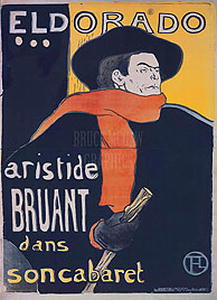
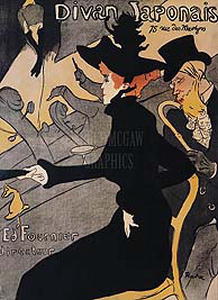
“[He] painted no landscapes, no religious pictures, no abstract conceptions. All his subjects, except for a few representations of animals, were real people whose lives were an integral part of his own life. “Gerstle Mack, from Toulouse-Lautrec (1938).
Lautrec begins his schooling at the Lycee Fontanes in Paris and his interest in art can already be seen as he frequented the studio of Rene Princeteau. At the age of 14 he fractured his legs leaving him permanently stunted. In 1882 he became a pupil of Bonnat and a year later of Cormon.
In 1885 with an allowance he sets himself up in a studio in Montmartre and begins to draw for illustrated journals. Meeting van Gogh in 1886, Lautrec came into contact with Impressionism and Post-Impressionism. From 1888 he begins to paint scenes and characters from society around him. Thus pictures of theatres, cafes, music-halls (most often the Moulin Rouge) and brothels can be seen again and again in Lautrec’s work. In 1889 he exhibits for the first time at the Salon des Independents and two years later produces his first poster for the Moulin Rouge. By 1894 Lautrec takes up residence in the brothel in the Rue des Moulins and by now he was fully immersed in the drinking and debauchery of this seamier side of Parisian life. Works such as ‘Les Deux Amies’ (c.1894) and ‘La Goulue Dancing’ (1895) for example are just two of the many paintings he produced that documented these ‘fin-de-siecle’ scenes. By 1899, due to excessive living, Lautrec is taken to an asylum at Neuilly with an attack of delirium tremens. Upon release he can’t help but return to his hard-drinking ways and two years later he dies from a paraltyic attack.
Despite his short life, Lautrec managed to produce some 737 canvases, 275 watercolours, 368 prints and posters and 5,084 drawings. His works provide an amazing document for the years 1880 to 1900, a period described as ‘la belle epoque’. The extraordinary characters in his paintings from clowns to aristocrats, from sportsmen to prostitutes cover a broad social spectrum. His works were always striking with bold forms and colours. His influences probably came from Goya in Lautrec’s etchings and Degas in his painting. A friendship with Gauguin certainly led Lautrec in a particular direction in his lithographs, inspired by Japanese colour prints. Despite his colourful life, his vast oeuvre covers a precise time and place with extraordinary detail, evoking the atmosphere of this time perfectly.